OOP Primer
On this page we will learn
- that OOP is a way of organising programs using objects
- what the terms class, object, attribute and method mean
- the difference between a class and an object
- how objects interact using methods
- how encapsulation and abstraction appear in simple Python code
Terminology
- class – a blueprint that describes a kind of thing, which we use to make objects that share the same attributes and methods.
- attribute – a quality that every object of a class has, such as a student's name, stored as data inside the object.
- instance – another name for an object, describing it as one particular copy made from a class.
- encapsulation – the OOP principle of storing important data inside an object and getting to that data through the object's methods.
- abstraction – the OOP principle of hiding the complicated code inside an object so we only need to call its methods.
This course teaches us to use object-oriented programming (OOP) in Python. Before we start building, we need to cover some of the basic ideas we'll meet along the way.
What is OOP?
OOP is a way of programming where we organise our code around objects. An object is like a digital version of a real thing.
In OOP, different objects work together. A simple way to understand this is to use a real-life example: imagine we want to create digital versions of students and the subjects they take.
What is an object?
The first "thing" in our example is a student. In OOP, the description of a kind of thing is called a class. So we would create a student class, and every student in our program would be made from that class.
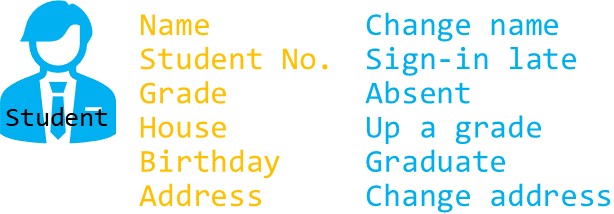
Let's use this image to represent our student class:

All students share certain qualities. In OOP, these qualities are called attributes. Students also do similar actions. These actions are called methods.
Below is our student class with its attributes (yellow) and methods (blue). We can think of a class as a blueprint. Every student object made from this blueprint has the same attributes and methods.
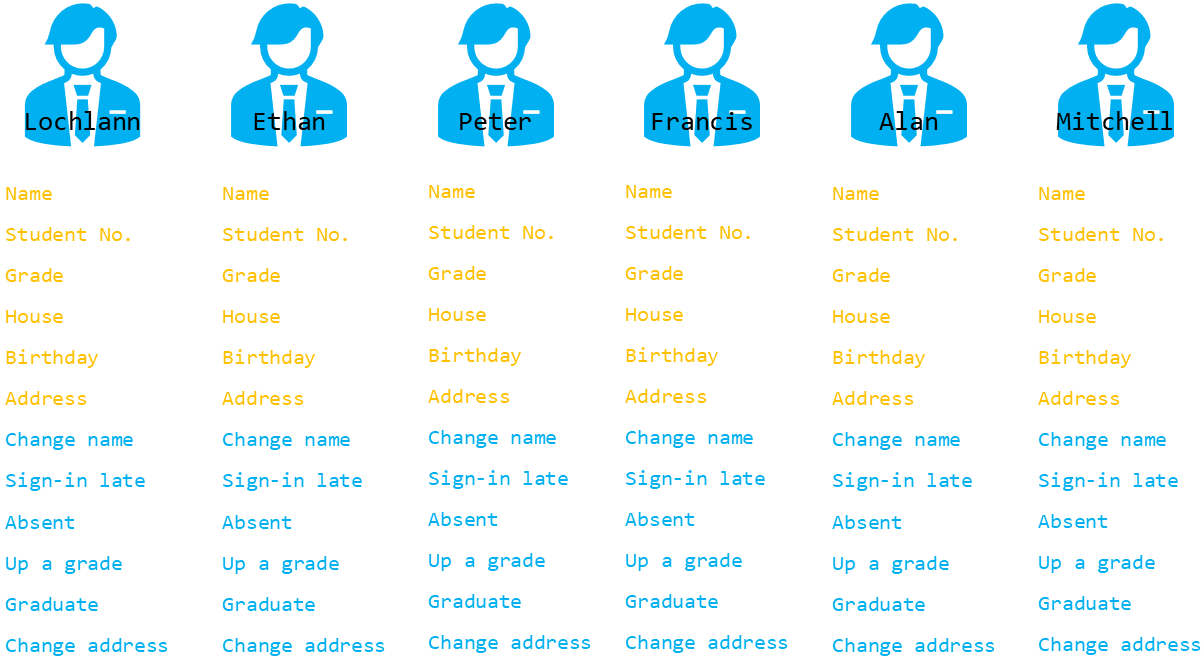
Once we have the student class, we can create actual students in our program. These are called objects (or instances of the class). Each object gets its attributes and methods from the class.
How does an object-oriented program work?
An object-oriented program works by changing objects through their methods. For example, a student object might have a method called change_name, which updates the student's name.
Objects can also work with each other. To show this, imagine we also have subject objects in the program.
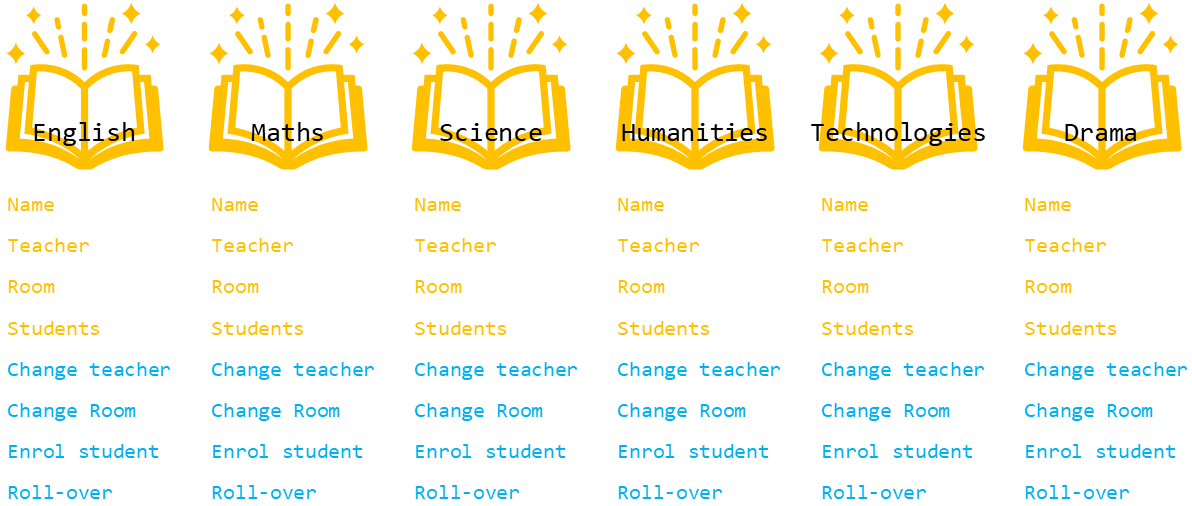
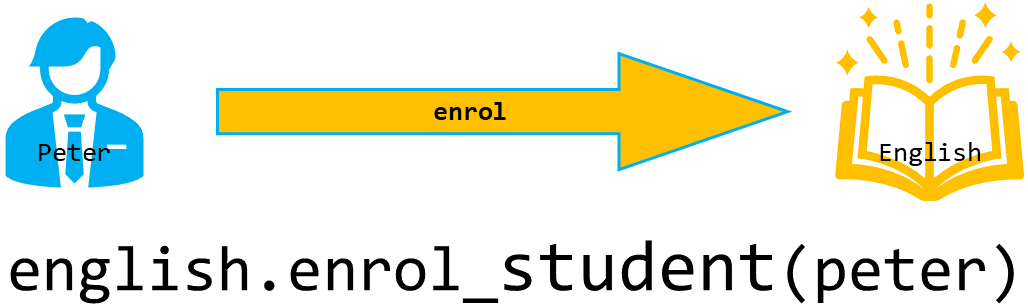
If we want to enrol a student in a subject, we call the subject's enrol_student method. For example, the English subject object can use its method to enrol Peter.
Encapsulation and abstraction
Look at the code shown under the last diagram. That's what this idea looks like in Python. It looks similar to code we've already used with turtle, like my_ttl.forward(10). That's because Python is an object-oriented language.
PRIMM
- Predict what you think will happen. Be specific.
- Run the program.
- Time to investigate the code. What does each line do?
Code explanation
- line 1 → imports the
turtlemodule, which contains theTurtleclass. - line 3 → creates a new turtle object from the
Turtleclass and stores it inmy_ttl. - line 5 → calls the turtle's
forwardmethod, which moves this turtle 100 steps.
All the time we've been programming in Python we've been using an object-oriented language; we just didn't know it. This example shows two of the main principles of OOP: encapsulation and abstraction.
Encapsulation means the important data is stored inside the object, and we get to that data through the object's methods. For example, the turtle has an x position, and we read it using xcor().
Abstraction means the complicated code inside the object is hidden from us. We don't see how the turtle moves; we just call forward(100) and it works.
Other OOP principles
OOP has two more important ideas: inheritance and polymorphism. We'll learn about these in Stage 4.